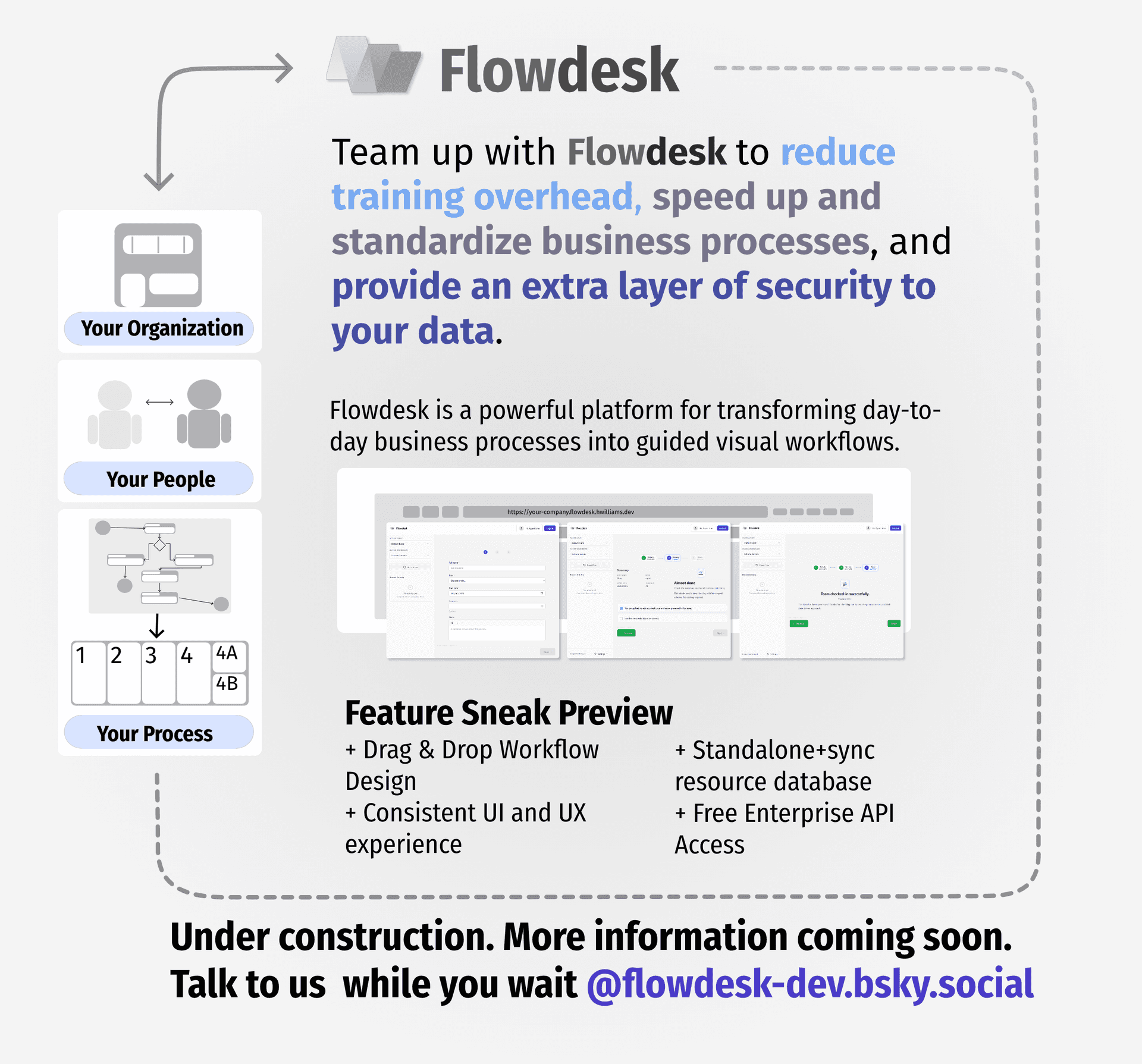
Flowdesk: A Flow-based support platform designed for event-based organizations.


It's not just "make the UI simpler" but "make a day-one hire perform like a veteran on this task, every time." Alt text
App Overview

Flowdesk is a microservices platform for breaking down complex business processes into guided workflows. The focus here is on collapsing the gap in time it takes to perform tasks between a novice agent and an expert one.

The even shorter version: Two agents doing the same check-in shouldn't take 90 seconds and 6 minutes. Flowdesk as a product seeks to compress that spread in variance.

As an objective it is measurable, demonstrable, and directly tied to money (labor cost, queue length, guest satisfaction, throughput per desk). The metric is time-to-task and its variance - not just the average.

It's not just "easy software. It's not just "make the UI simpler". It's "make a day-one hire perform like a veteran on this task, every time."

Preview: Flowdesk Development Site

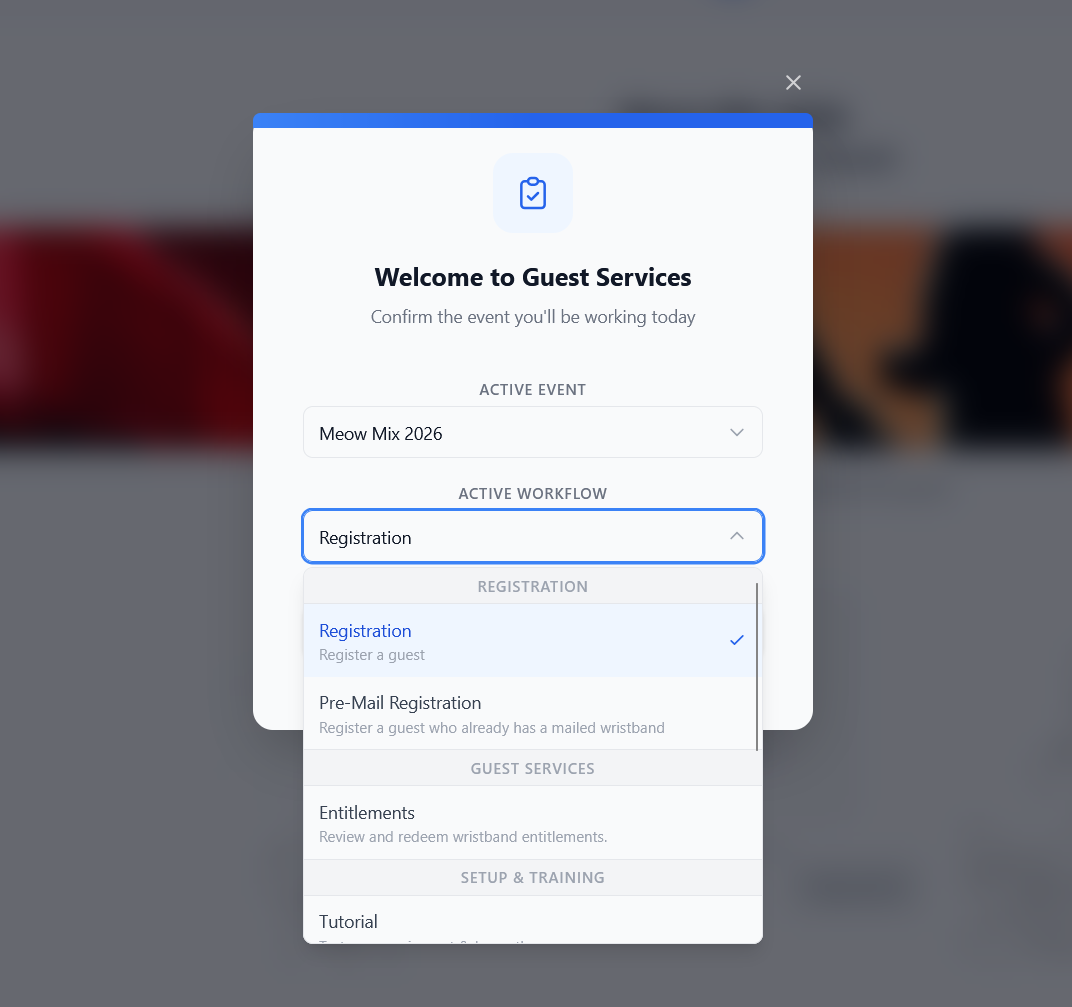
State driven navigation and visual consistency between controls make complex tasks feel easier. Alt text

Private Repository

This is a real product that is in development. The source code is not public, but the platform may soon be available as a service or for licensing. Please contact me for more information or exceptions to this.

A step demonstrating input components. Alt text
A short video of the platform's operation. This is a custom implemntation of the architecture for a specific event. The platform is highly configurable and can be used for many different business processes.

Details

In Flowdesk, an interaction is the behavior that occurs between a guest and an agent. An agent is a real-person who is interacting with this guest in order to exchange information or complete some task.

A front-desk employee at a hotel checking in a guest is an easy to reach example.

A standard conversation flow Alt text

A normal business day might see these interactions repeated hundreds or thousands of times, and the time taken to complete these interactions might vary significantly from one agent to another. Each agent can also generally only handle one interaction at a time.

A line of workflows waiting to happen Alt text

Scale this up.

Hundreds of guests, or thousands of guests arriving at a high rate. A once a year event, if you will.

An surge of workflows happening all at once Alt text

Okay, most organizations aren't going to have a single agent out there handling such scale, but even with numerous agents the variance in handling time is a real bottleneck to operations. Little variances in the amount of time spent might have a very high cumulative impact on a business' ability to scale operation to bursts in demand.

Flowdesk envisions breaking these interactions down into streamlined, consistent, efficient, repeatable, and flexible workflows that can be completed by agents of any skill level with minimal training.

The images below are more technical documentation, but they do look neat. Bonus points if you get it.

A workflow divides some business process into a sequence of steps.
A workflow is easy to repeat or abandon.
A workflow may allow traversal between steps.

There is a minimum amount of time that it takes an agent to complete a task in a UI, on average, and a reasonable maximum amount of time that might be spent on the same task in the same UI, on average. Flowdesk compresses the space between the minimum amount of time taken to complete a task and the maximum aount of time taken.

Attempt to demonstrate variance in workflows.

Flowdesk Process

The prerequisite to a good set of Flowdesk is to identify the tasks that are being performed by agents and the time taken to complete these tasks. Most tasks can be broken down into sequences of steps, and these steps can be made into workflows that are repeatable and consistent.

You divide these more modular tasks into stages, and then create consistent UX/UI experiences for each of these stages. Some tasks share stages, and some stages are unique to a task. Some stages are simple, and some stages are complex. Some tasks may even involve one another.

Task identification from business analysis are made into functional workflows that support reducing the time taken to complete tasks while also addressing the variability in how much time that it takes to complete these tasks.

Flowdesk is not a one-size-fits-all solution, but it is a platform that can be used to create solutions for many different business processes. Just 50% coverage of tasks can have a significant impact on organizations that have a high volume of interactions with their customers, clients, or guests. See the testimonial below for a real-world example of how this platform was used to improve the guest experience at a large convention in Atlanta, Georgia.

Technical document. Partial app structure. Workflow architecture

Steps

A step can contain any type of work, and can be used in multiple workflows.

An identification step for a check-in process using the default template might look like such:

The general feel of a workflow step. Example Step

In this picture, a guest has had their member ID scanned on the first and their profile information is displayed. The first step is now locked and the agent must reset to go back.

The area with a marching border on the right side integrates an external barcode scanner in order to read information on the back of US driver's license.

This information is compared with the displayed profile on the left, and discrepencies are highlighted in yellow.

Checking the acknowledgement box at the bottom moves the workflow into the next step by fulfulling the step advancement conditions.

The major components of this UI. Example Step

Implementation

This platform was implemented as a solution for in-person registration, VIP registration, pre-event mailouts, and entitlements fulfillment for an Atlanta-based organization's yearly convention for May 2026, where it achieved significant success: The setup consists of a Vue 3 frontend and a configurable backend interface. This particular implementation utilized a Perl catalyst backend. Standard 2D barcode scanning devices and RFID tag readers were used in the guest identification system and have out-of-the box modular support in flows created on the platform.

Some Stats:
  • Single day registration of over 10,000 guests with an average processing time of about 45 seconds.
    • Previous year: ~2 minutes.
  • No single guest wait time greater than 10 minutes.
    • Previous year had lines that wrapped around the entire building and there were stories of four hour waits.
A testament Example Step

A real-world solution for event staff and volunteer management.